Your preoperative plan, physically in your hands — positioned exactly where it needs to be.
Surgical guides translate preoperative planning into intraoperative precision. They are patient-matched physical tools — designed from the patient's own anatomy — that position the surgeon's instruments exactly where the plan dictates, reducing reliance on intraoperative judgement for decisions that can be made in advance.
For procedures where angular accuracy, resection depth, or implant positioning must be controlled within tight tolerances, a well-designed surgical guide removes a significant source of intraoperative variability. It does not replace the surgeon's skill — it supports it, by removing uncertainty from the elements of the procedure that can be engineered in advance.
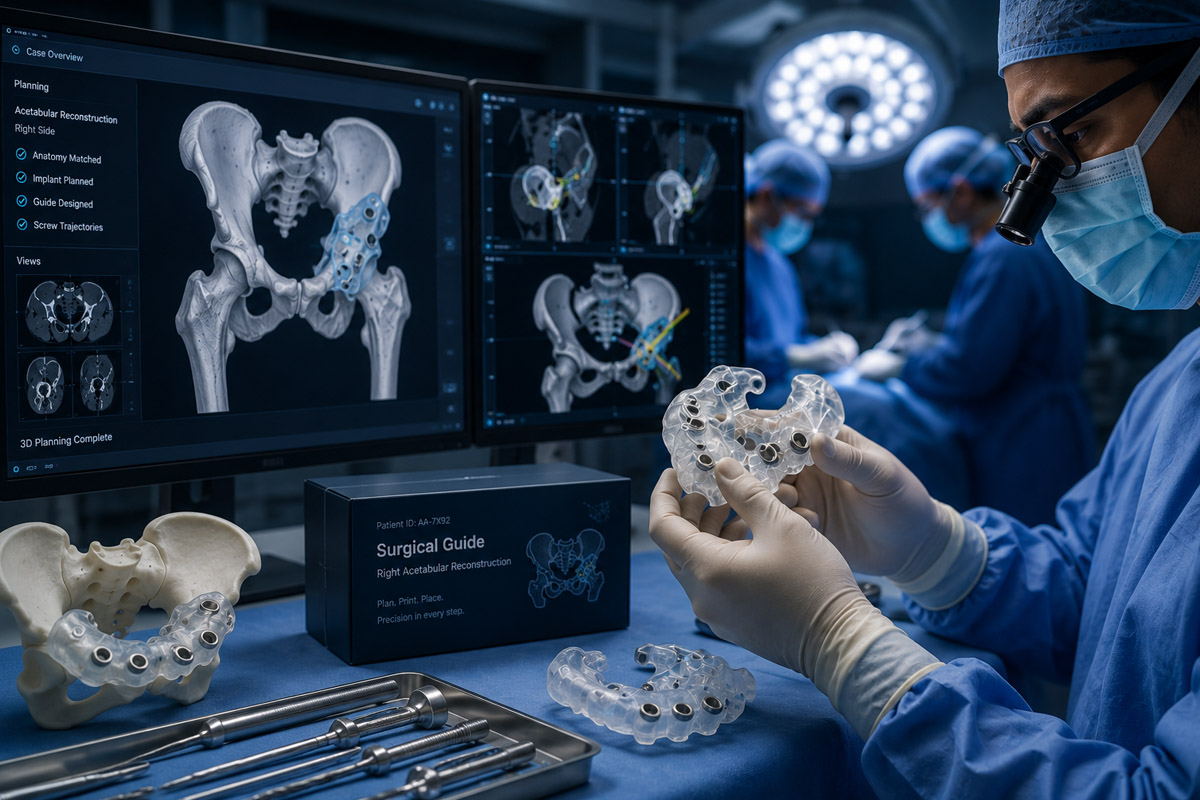
Each guide type is derived from the patient's segmented anatomy and designed for a specific intraoperative function.
Patient-matched guides that define precise osteotomy planes and resection margins — ensuring accurate bone cuts in arthroplasty, osteotomy, and oncological resection procedures. Each guide seats on specific anatomical landmarks unique to the patient.
Precision templates for screw trajectory, pedicle entry point, and fixation placement — controlling depth, angle, and position in spinal and orthopaedic procedures where drilling accuracy is critical to construct stability.
Custom alignment and seating tools for implant positioning, fragment reduction, and reconstruction — ensuring the operative result matches the preoperative plan in cases where spatial accuracy determines functional outcome.
Guides for oncological resection that translate planned tumour margins directly to the surgical field — enabling safe, geometrically accurate bone cuts that respect oncological boundaries while preserving surrounding structures.
Six procedure types where patient-specific guides deliver measurable intraoperative advantage.
Cutting and alignment guides for total knee and hip replacement — controlling resection planes and implant positioning to achieve target alignment and restore joint mechanics.
Pedicle screw trajectory guides for fusion procedures — reducing fluoroscopy time and improving accuracy of screw placement in complex spinal anatomy.
Cutting guides for mandibular and midface osteotomies in orthognathic surgery — translating virtual surgical planning directly to the operative field.
Positioning and alignment jigs for craniofacial reconstruction — ensuring symmetry and anatomical accuracy in complex orbital, frontal, and cranial procedures.
Oncological resection guides that define safe margins in primary bone tumour surgery — enabling wide resection with clear margins while preserving surrounding neurovascular structures.
Guides for revision knee and hip cases with compromised bone stock or atypical anatomy — enabling accurate implant positioning where standard instruments cannot be reliably used.
| Parameter | Detail |
|---|---|
| Material | Biocompatible surgical-grade resin (standard) or stainless steel where thermal sterilisation tolerance is required. Material selected based on procedure requirements and surgeon preference. |
| Sterilisation | Compatible with standard hospital autoclave cycles. Full sterilisation instructions provided with each guide. Single-use by default — reusable options available on request. |
| Fit Validation | Every guide verified against the patient's digital anatomy model before dispatch. Fit confirmed on virtual simulation prior to manufacture. |
| Standard Turnaround | 5–7 working days from receipt of approved segmentation data and design sign-off. |
| Urgent Turnaround | Available on request — contact our clinical team directly for time-sensitive cases. |
Converting patient CT and MRI scans into precise 3D anatomical reconstructions — the foundation for every guide we produce.
Learn more →Custom implants in titanium, PEEK, and PMMA — engineered from individual anatomy, surgeon-reviewed before manufacture.
Learn more →High-fidelity physical replicas for surgical rehearsal, MDT briefings, and patient consent at true scale.
Learn more →Submit your case and our clinical team will discuss the guide type, material, and timeline that best fits your surgical plan.