Introduction
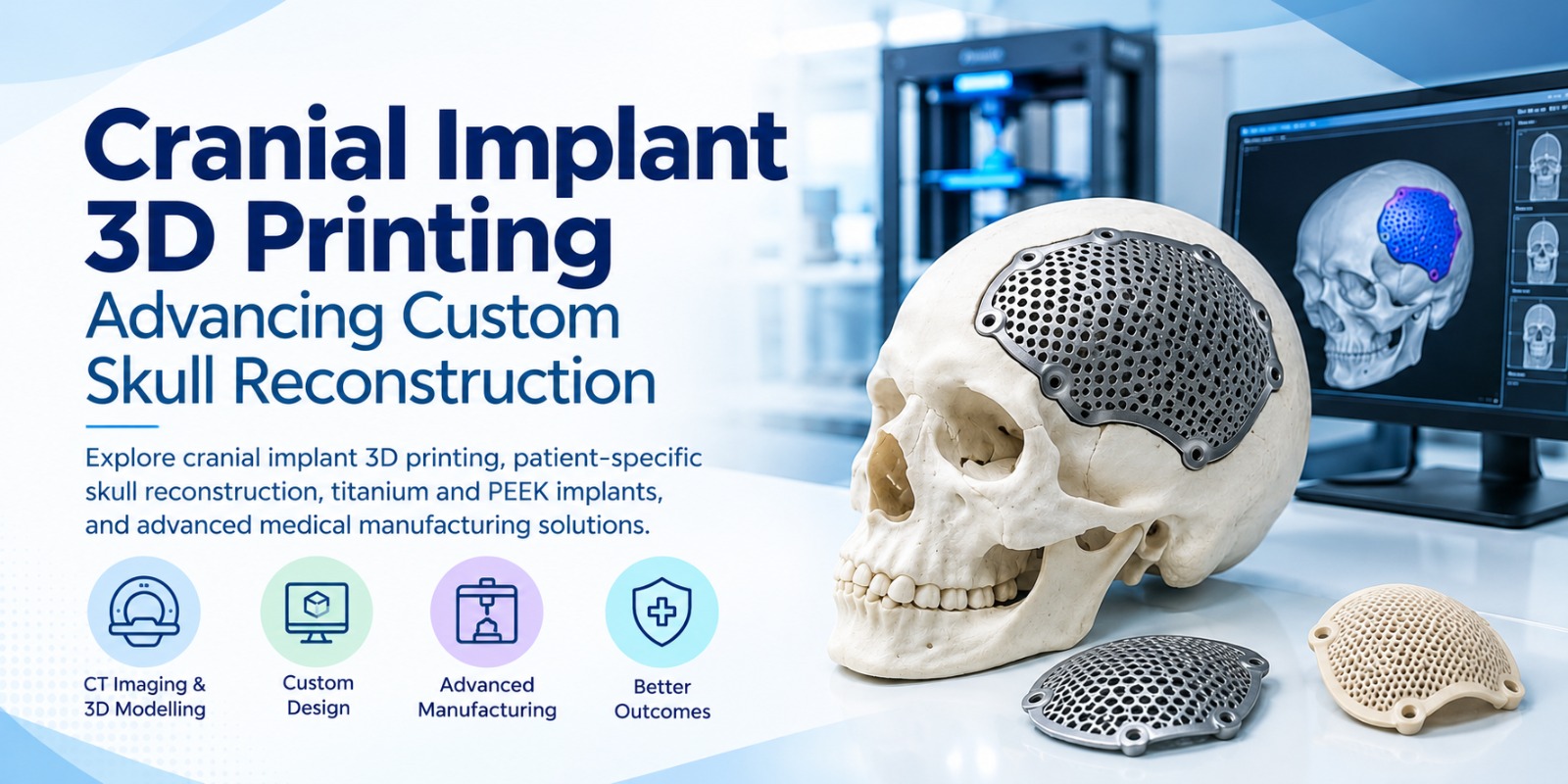
Advancements in medical manufacturing have transformed the approach to complex skull defects and cranial reconstruction. Cranial implant 3D printing enables the development of customised implant designs based on individual anatomical data and clinical requirements.
Skull defects can result from traumatic injuries, neurosurgery, tumour removal, or congenital conditions. In selected cases, patient-specific cranial implants can help address complex reconstructive requirements through digital planning and precision manufacturing.
By combining CT imaging, 3D anatomical modelling, computer-aided design (CAD), and additive manufacturing, medical engineering teams can develop implant designs tailored to individual patients. Atomic Additive provides specialised medical manufacturing and surgical planning solutions for complex reconstructive applications.
What Is Cranial Implant 3D Printing?
Cranial implant 3D printing is a manufacturing approach used to create customised implants for selected skull reconstruction procedures. The process involves converting medical imaging data into a digital anatomical model, designing the implant, and manufacturing it using an appropriate material and validated process.
Unlike standardised implants, patient-specific cranial implants are designed around the dimensions and contours of an individual skull defect. This approach can support surgical planning and help address complex anatomical requirements.
Learn more about patient-specific cranial and medical implants.
How Does 3D Printing for Cranial Implants Work?
The manufacturing process typically involves the following stages.
1. CT Imaging and Data Collection
A CT scan provides detailed information about the patient's skull and the location and extent of the defect. Accurate imaging data is essential for developing a suitable digital reconstruction.
2. Image Segmentation and 3D Modelling
Specialised software processes the imaging data to create a three-dimensional representation of the skull. This model helps the engineering team assess the defect and plan the implant's shape.
Explore segmentation and surgical planning services for related anatomical modelling workflows.
3. Custom Cranial Implant Design
The implant is digitally designed according to the patient's anatomy, defect dimensions, fixation requirements, and clinical objectives. The treating surgeon reviews the proposed design before manufacturing.
4. Material Selection and Manufacturing
Depending on the intended application, materials such as titanium or PEEK may be considered. The selected material and manufacturing method must meet the relevant safety, performance, and regulatory requirements.
5. Quality Inspection
After manufacturing, the implant undergoes appropriate finishing, dimensional inspection, and quality verification before clinical use.
For specialised manufacturing requirements, explore custom medical device manufacturing in Coimbatore.
Benefits of 3D-Printed Cranial Implants
Patient-specific cranial implant manufacturing offers several potential advantages for suitable clinical applications.
- Customised design: Implants can be designed around individual skull defects.
- Anatomical precision: Digital modelling helps assess the geometry of the reconstruction site.
- Improved surgical planning: Three-dimensional representations help clinicians visualise complex anatomy.
- Support for complex cases: Custom designs can address irregular or extensive skull defects.
- Digital workflow integration: Imaging, design, and manufacturing can be coordinated within a connected process.
The clinical outcome depends on the patient's condition, implant suitability, manufacturing quality, and the treating surgical team's expertise.
Applications of Cranial Implant 3D Printing
Cranioplasty After Traumatic Injury
Severe head injuries can result in skull defects requiring reconstruction. Custom cranial implants may be considered to address these defects following appropriate clinical assessment.
Reconstruction After Neurosurgery
Some neurosurgical procedures leave skull defects that require subsequent reconstruction. Patient-specific implant designs can support planning for selected cases.
Explore 3D-printed neurosurgery implants for related neurosurgical reconstruction applications.
Cranial Reconstruction After Tumour Removal
Tumour removal may leave defects that require specialised reconstructive planning. Implant design depends on the defect's location, surrounding anatomy, and clinical requirements.
Learn more about 3D-printed oncology implants.
Cranio-Maxillofacial Reconstruction
Complex injuries or surgical procedures may affect both the skull and facial bones. In such cases, coordinated planning can help address different anatomical requirements.
Explore cranio-maxillofacial implant manufacturing for additional reconstructive applications.
Materials Used in Cranial Implant Manufacturing
Choosing the right material is essential for the safety, performance, and suitability of a cranial implant.
Titanium Cranial Implants
Titanium is used in medical implant applications because of its mechanical properties and corrosion resistance. Its suitability depends on the implant design, manufacturing process, and intended clinical use.
PEEK Cranial Implants
Polyether ether ketone (PEEK) is a high-performance polymer used in selected medical implant applications. It may be considered for particular reconstructive designs depending on the clinical and engineering requirements.
Explore PEEK medical implant manufacturing to understand more about this material.
PMMA and Other Materials
PMMA is also used in selected cranial reconstruction procedures. Material selection must consider the intended use, product specifications, clinical requirements, and applicable regulatory standards.
Role of 3D Anatomical Models and Surgical Guides
Alongside cranial implant design, digital manufacturing can support surgical preparation through anatomical models and procedure-specific guides.
3D-printed anatomical models provide physical representations of patient anatomy, helping surgical teams assess defects and understand spatial relationships before an operation. Explore 3D-printed anatomical models for surgical planning.
Patient-specific surgical guides can help transfer selected elements of a digital surgical plan into clinical practice. Their use depends on the procedure and the requirements of the individual case. Learn more about 3D-printed surgical guides in Tamil Nadu.
These technologies serve different purposes but can complement appropriate preoperative planning workflows.
CT Imaging → Segmentation → 3D Model → Implant Design → Surgeon Review → Manufacturing → Quality Inspection
Challenges in Cranial Implant 3D Printing
Despite its potential benefits, cranial implant manufacturing requires careful attention to several factors:
- Imaging accuracy: Errors in source data or segmentation can affect implant design.
- Material suitability: Each material must be appropriate for its intended clinical application.
- Manufacturing quality: Dimensional accuracy, finishing, and quality control are essential.
- Regulatory compliance: Medical devices must meet applicable requirements for safety and performance.
- Clinical evaluation: The treating surgical team must determine whether the implant is suitable for the patient.
Addressing these factors helps ensure that the manufacturing process aligns with the clinical requirements.
The Future of Cranial Implant 3D Printing
The future of cranial implant 3D printing is closely connected to advances in medical imaging, digital modelling, additive manufacturing, and implant materials.
As these technologies develop, patient-specific design may continue to support complex skull reconstruction and preoperative planning. Collaboration between medical professionals and engineering teams remains essential to translating digital designs into appropriate clinical solutions.
Atomic Additive's work in medical manufacturing, anatomical modelling, and specialised implant solutions reflects the growing role of precision engineering in complex medical applications.
Conclusion
Cranial implant 3D printing is advancing the approach to customised skull reconstruction by combining medical imaging, digital design, and precision manufacturing. From cranioplasty after traumatic injuries to reconstruction following neurosurgery or tumour removal, this technology can support the development of implants tailored to individual anatomical requirements.
Selecting the right material, manufacturing method, and implant design requires appropriate clinical assessment, quality verification, and regulatory compliance.
To learn more about patient-specific medical manufacturing and specialised implant solutions, visit Atomic Additive.
Frequently Asked Questions
1. What is cranial implant 3D printing?
It is a manufacturing approach that uses digital anatomical data and additive manufacturing to produce customised implants for selected skull reconstruction procedures.
2. Which materials are used for cranial implants?
Depending on the application, materials may include titanium, PEEK, or PMMA. Suitability depends on the product and its intended clinical use.
3. When are cranial implants required?
They may be considered for skull defects caused by trauma, neurosurgery, tumour removal, or other conditions requiring reconstruction.
4. How does 3D printing support cranial reconstruction?
It supports digital implant design, anatomical visualisation, and the production of customised components for suitable clinical applications.
5. Where can I learn more about medical 3D printing?
Visit Atomic Additive to explore its medical manufacturing and patient-specific planning services.
Explore Advanced Medical 3D Printing
Connect with Atomic Additive for patient-specific medical solutions, advanced additive manufacturing, digital engineering and 3D printing requirements.