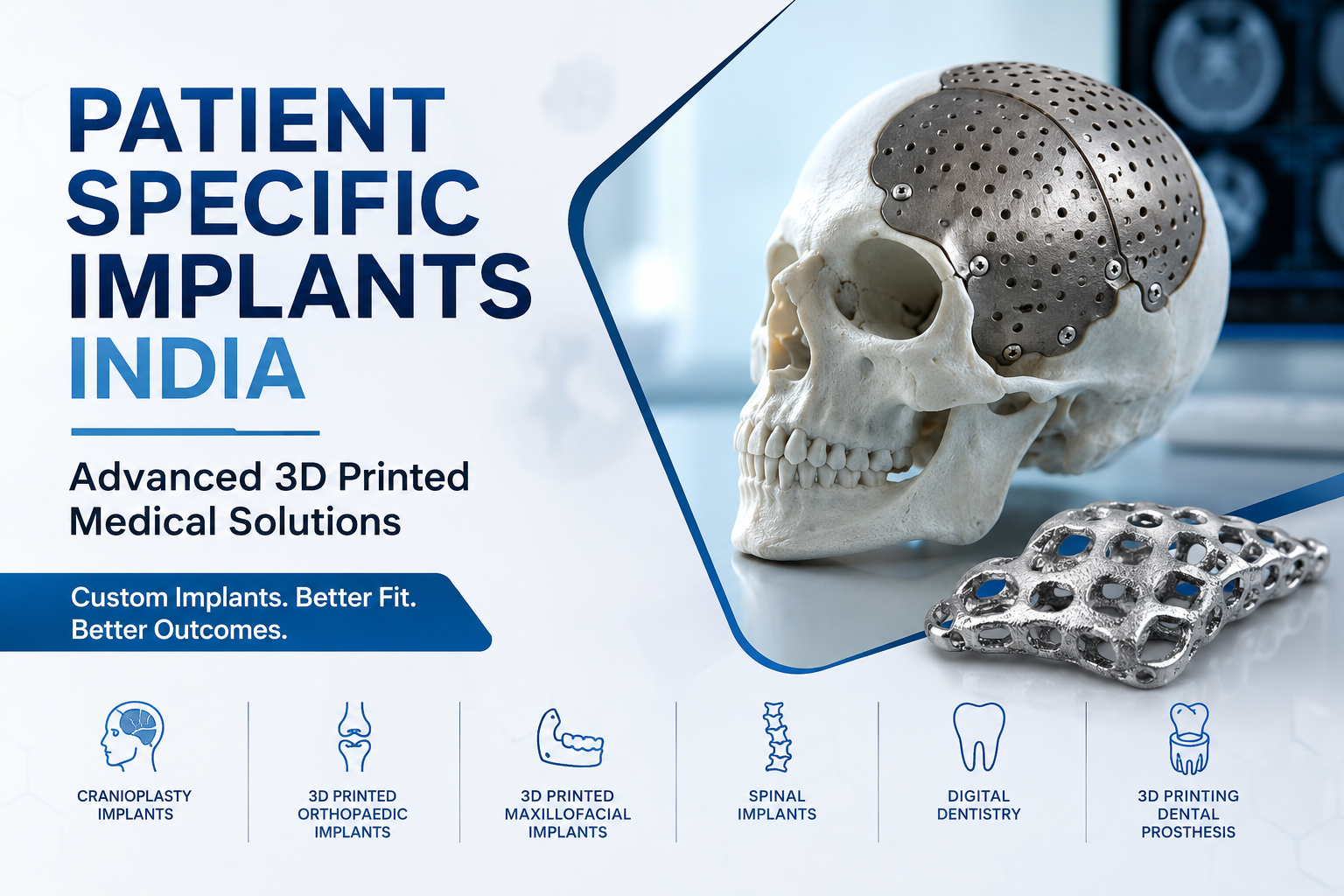
The healthcare industry is rapidly embracing personalized treatment solutions, and Patient Specific Implants are leading this transformation. Unlike conventional implants, which are manufactured in standard sizes, Patient Specific Implants are custom-designed using a patient's unique anatomy. This innovative approach combines advanced medical imaging, digital engineering, and 3D printing technology to create implants that match individual clinical requirements.
As the demand for precision medicine grows, Patient Specific Implants India have become an important advancement in modern healthcare. Medical technology companies in Coimbatore, Tamil Nadu, are contributing to this evolution by developing customized implant solutions, surgical planning tools, and advanced medical devices that support surgeons in managing complex procedures with greater confidence.
What Are Patient Specific Implants?
Patient Specific Implants are customized medical implants designed from patient-specific CT or MRI scans. Using digital imaging, biomedical engineers convert anatomical data into highly accurate three-dimensional models before designing an implant tailored to the patient's anatomy.
Unlike conventional implants, Patient Specific Implants are developed to address complex anatomical conditions where a personalized solution can support surgical planning and reconstruction.
These implants are widely used in:
- Cranioplasty procedures
- Orthopaedic reconstruction
- Oral and Maxillofacial surgery
- Spine surgery
- Oncology reconstruction
- Trauma reconstruction
How Are Patient Specific Implants Developed?
The development of Patient Specific Implants follows a sophisticated digital workflow that combines engineering expertise with clinical knowledge.
1. Medical Imaging
The process begins with high-resolution CT or MRI scans that capture detailed anatomical information.
2. Digital Segmentation
Advanced software separates the affected anatomy from surrounding structures, producing an accurate digital representation.
3. Anatomy Models
The anatomical data is transformed into Anatomy Models and 3D Printed Anatomy Models, allowing surgeons to visualize complex structures before surgery. These models improve communication between engineers and surgeons while supporting preoperative planning.
4. Implant Design
Biomedical engineers design Patient Specific Implants using CAD software while collaborating with surgeons to ensure the implant meets the required clinical objectives.
5. Advanced Manufacturing
The final implant is manufactured using medical-grade materials and advanced additive manufacturing technologies, including 3D Printed Titanium Implants and high-performance polymers for selected medical applications.
Benefits of Patient Specific Implants
Patient Specific Implants offer numerous advantages compared to conventional implant solutions.
Improved Anatomical Fit
Every implant is designed according to the patient's anatomy, providing a customized solution for complex reconstruction.
Better Surgical Planning
The combination of 3D Printed Anatomy Models and customized implant design enables surgeons to plan procedures more effectively before entering the operating room.
Personalized Healthcare
Customized implants support the growing trend toward personalized healthcare, where treatment is developed around the individual rather than standardized devices.
Advanced Medical Engineering
Modern digital workflows integrate medical imaging, engineering, and additive manufacturing into one seamless process that enhances precision throughout implant development.
Applications of Patient Specific Implants
Cranioplasty Implants
Cranioplasty Implants are developed to reconstruct skull defects caused by trauma, congenital conditions, or previous surgical procedures. Patient-specific design enables accurate reconstruction based on individual cranial anatomy.
3D Printed Orthopaedic Implants
Complex bone defects often require customized reconstruction. 3D Printed Orthopaedic Implants are designed to address challenging anatomical conditions while supporting personalized treatment strategies.
3D Printed Maxillofacial Implants
Facial reconstruction requires exceptional precision. 3D Printed Maxillofacial Implants and 3D Printed Oral Maxillofacial Implants can be designed for mandibular reconstruction, orbital floor reconstruction, facial trauma, and congenital abnormalities.
Spinal Implants
Customized Spinal Implants are increasingly being explored for complex spinal reconstruction procedures where patient anatomy varies significantly.
Digital Dentistry
The advancement of Digital Dentistry has transformed restorative and reconstructive dental treatments. Digital workflows improve treatment planning while enabling highly accurate dental restorations.
3D Printing Dental Prosthesis
Modern 3D Printing Dental Prosthesis technologies provide improved precision and digital manufacturing capabilities for customized prosthetic solutions, supporting efficient dental workflows.
Why 3D Printing Is Changing Medical Implant Manufacturing
Medical 3D printing has transformed the way customized implants are designed and manufactured. Unlike traditional manufacturing methods, additive manufacturing enables engineers to produce highly complex geometries while reducing material waste and improving design flexibility.
Today's medical 3D printing technologies support:
- Patient Specific Implants
- 3D Printed Titanium Implants
- 3D Printed Orthopaedic Implants
- 3D Printed Maxillofacial Implants
- 3D Printed Anatomy Models
- Surgical Planning Models
- Digital Dentistry Applications
- 3D Printing Dental Prosthesis
These innovations continue to improve collaboration between healthcare professionals and engineering teams while supporting personalized medical care.
The Growing Role of Anatomy Models
Before surgery, understanding complex anatomy is essential. Anatomy Models and 3D Printed Anatomy Models allow surgeons to evaluate patient anatomy, practice complex procedures, and optimize surgical strategies before entering the operating room.
These models improve surgical confidence and support better communication between multidisciplinary medical teams.
Why Patient Specific Implants Are the Future of Healthcare
The future of healthcare lies in personalized treatment. Patient Specific Implants combine medical imaging, engineering expertise, and advanced manufacturing to create customized solutions that address the unique anatomical needs of every patient.
As hospitals increasingly adopt precision medicine and digital surgical planning, customized implant technology will continue to transform cranial reconstruction, orthopaedic surgery, maxillofacial reconstruction, spinal procedures, and digital dentistry.
Medical innovation is growing rapidly across India, and technology-driven companies in Coimbatore, Tamil Nadu, are helping shape the future of advanced medical manufacturing through patient-focused engineering solutions.
Conclusion
Patient Specific Implants represent one of the most significant advancements in modern medical technology. By integrating advanced medical imaging, 3D Printed Titanium Implants, 3D Printed Orthopaedic Implants, Cranioplasty Implants, 3D Printed Maxillofacial Implants, Anatomy Models, 3D Printed Anatomy Models, Digital Dentistry, and 3D Printing Dental Prosthesis, healthcare providers can move toward more personalized and precise treatment approaches.
As the adoption of medical 3D printing continues to expand across India, Patient Specific Implants will remain at the forefront of innovation, enabling surgeons to deliver customized care with greater precision and confidence while improving the future of personalized healthcare.
📍 Atomic Additive — Parsn Sesh Nestle, Ramanathapuram, Coimbatore – 641 036, Tamil Nadu, India.
📞 +91 98946 21003 | ✉️ pranaiparthiban5@atomicadditive.com